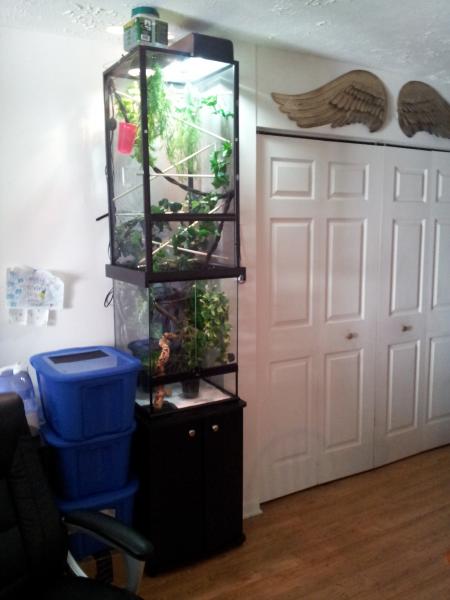
I'll be a bit obstinate and fess up- I used medium to largish glass aquaria for breeding chameleons for several years when I started (early 90s). The breeder who sold me my first pair also used glass aquaria. He bred several species successfully over and over again in those tanks, and so did I, and some of the species I bred were not the same as the ones that he bred. Between the two of us, we produced at least a dozen species in aquarium tanks. Maybe a dozen and a half even.
I would put some of those early breeders up against anyone's even today as far as health and vigor and coloration and longevity.
The forum member who came up with the low temperature strategy for lengthening the lifespan of female veileds had some of the longest lived female veileds ever known, mentioned she had someone studying and doing a paper on her females, and she once posted that she kept them in medium/smallish sized glass aquarium tanks as well. And here she had some of the longest lived female veileds ever, if not THE longest lived.
Personally I think the whole glass thing, whether there is lots of airflow or not, is just a big myth. It is no more true for these lizards than for other lizards of similar size and arboreal habits that are kept and bred in glass enclosures or tanks every day.
I believe the glass tank myth spread when certain editors of a certain newsletter that was popular before the internet was widespread really pushed the concept of screen cages being absolutely necessary in every issue of that newsletter after they became the editors. Before them, that was not the sole view of that newsletter. After them, many noobs who never tried glass became absolutely hateful towards anyone admitting to using glass.
Because success with chameleons was in its infancy and the popularity of these lizards rose alongside the popularity of the newsletter once these editors took it over (and put a really professional and excellent polish on it), I think the whole screen thing became ingrained in everyone's mind as one of the reasons we were now successful with these lizards, forgetting that at the same time screen cages became the thing to use, there were also huge advances in veterinary medicine, understanding of diet and temperature requirements, the invention of lizard-specific decent supplementation products, new lighting products, etc etc that came along at the same time as the rise in popularity of these lizards. Basically- there were huge advances in all areas of herpetoculture and support products and services in the 90s as chameleons rose in popularity.
I'm not hacking on the editors of that excellent newsletter at all- it's just that sometimes when there are multiple variables at play that all come into existance at approximately the same time, it can be difficult to isolate which are critical and which are not critical, but are still excellent functional ingredients in the recipe of success... Functional ingredients that are not critical can always be substituted with other functional ingredients...
All that said, screen cages do have some excellent things going for them- they are much cheaper per cubic foot, and can be used outdoors weather permitting. That is why I use them today. I like big cages for quality of life reasons for the lizards after using much smaller enclosures in that past time. There is something really beautiful and rewarding about watching a chameleon stretch out and walk someplace.
But indoors in my living room- if I had chameleons there (and I don't- our free-roaming house iguanas now occupy that space), no thanks on screen enclosures.
Edit- and oh yeah- I didn't use fans, the other breeder I knew didn't use fans, another breeder/friend/veterinarian who bred jacksons over a few generations who used aquaria didn't use fans, and neither did the forum member who had the longest lived veiled females. We all used plants though- especially pothos vines I used. And if the tank is medium sized there will always be some airflow/exchange simply by the chimney effect- warmed air under the basking light rises up and out of the tank, pulling cool air in and across the bottom towards the light.
Edit edit- as far as humidity- I don't think any of us used a hygrometer as far as I know. I never worried about it because humidity issues never gave my chameleons problems. But if you lightly mist a couple times a day (once morning, once evening) and drip once a day into a catch bowl and have a potted vine in there respirating, humidity should be fine. Never saw any mold or anything of the sort, and the lizards always shed just fine.