Chameleon Info:
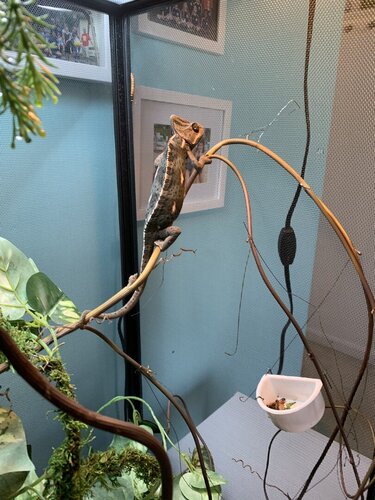
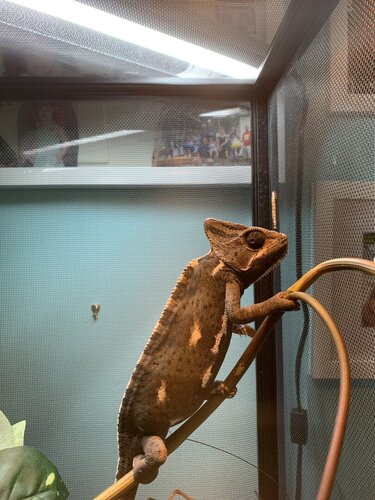
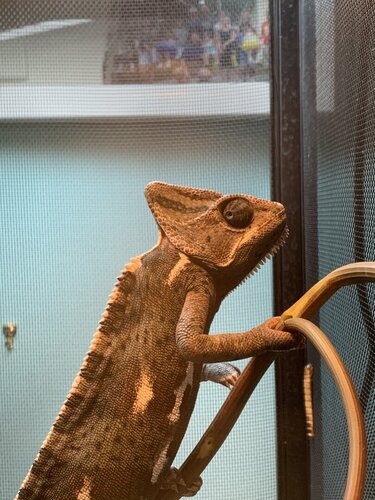
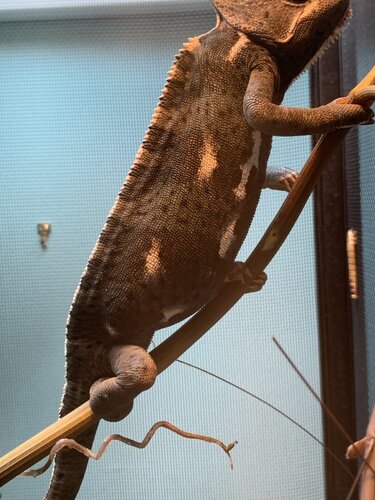
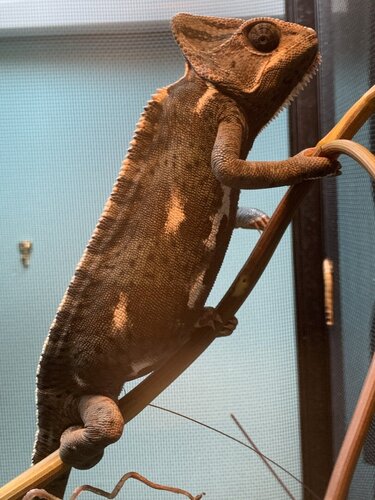
- Your Chameleon - The species, sex, and age of your chameleon. How long has it been in your care? Veiled Chameleon, female, and 6-10 months old. Been in my care for 3 days.
- Handling - How often do you handle your chameleon? I have not handled her at all. This is good. You'll want to give her time to get comfortable.
- Feeding - What are you feeding your cham? What amount? What is the schedule? How are you gut-loading your feeders? Superworms, dubias, and crickets. She hasn't eaten. Too new to know the schedule. Gutloading with carrots, peppers, mustard greens, and collard greens. This is good! Fresh veggies are always best! You will want to feed her 3 large feeders (or equivalent) 3 days a week to keep her egg production down.
- Supplements - What brand and type of calcium and vitamin products are you dusting your feeders with and what is the schedule? Calcium without d3 everyday except sunday. Calcium with d3 and multivitamin on sunday, but switch each sunday. Perfect!!
- Watering - What kind of watering technique do you use? How often and how long to you mist? Do you see your chameleon drinking? Misting bottle. I mist every morning for 2-3 minutes and every night for 2-3. I have seen her drink. Also perfect. She may not want to clean her eyes if you're standing over her with a mister bottle, but for now this is fine! You may want to eventually get a mister system. Mist king is the best there is. And worth every penny!
- Fecal Description - Briefly note colors and consistency from recent droppings. Has this chameleon ever been tested for parasites? She has not pooped yet in my care. She has not pooped in my care yet. She has been tested for parasites. When she does, the fecal matter should be a formed pellet, and the urate should be creamy white. If there is an orange tinge to it, it will be fine as long as it is has white to it. If the whole thing is orange, she is dehydrated and you may want to provide her with some hornworms for moisture.
- History - Any previous information about your cham that might be useful to others when trying to help you. I got her from a friend who used a compact uvb.
Cage Info:
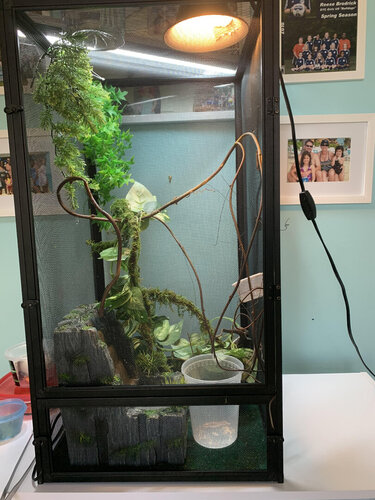
- Cage Type - Describe your cage (Glass, Screen, Combo?) What are the dimensions? 16x16x30 but getting a 2x2x4Great! A larger enclosure will provide you with more space for her lay bin. You'll want a permanent lay bin as part of her enclosure.
- Lighting - What brand, model, and types of lighting are you using? What is your daily lighting schedule? 24 inch t5 ho uvb bulb. 5.0 reptisun. 75 watt light bulb for basking. Good. How far away is her basking bulb from her enclosure? I like to recommend lifting them off the enclosure a few inches to prevent the risk of burns.
- Temperature - What temp range have you created (cage floor to basking spot)? Lowest overnight temp? How do you measure these temps? 72-84. 69 is the lowest overnight temp. Temperature gun. You will want a thermometer with a probe to attach to her basking branch so you always know the exact temp there. You want her basking spot to be no higher than 81. We like to keep the females cooler so it slows their metabolism so they dont feel so hungry since we keep them on a stricter diet.
- Humidity - What are your humidity levels? How are you creating and maintaining these levels? What do you use to measure humidity? Usually around 52%. Using a mister. Hygrometer. You will want to keep her daytime humidity between 30-50% and then at the coolest part of the night (I chose midnight-4am) you will want her humidity to spike to as close to 100% as you can get it. They want warm, dry days and cool, moist nights
- Plants - Are you using live plants? If so, what kind? I am not but I plan on getting some very soon. I think I have seen someone link a good plant list, but if not I'll link a couple below.
- Placement - Where is your cage located? Is it near any fans, air vents, or high traffic areas? At what height is the top of the cage relative to your room floor? The cage is located in a guest bedroom. Not near any fans or vents. Very low traffic. The top of the cage from the ground is 62 inches. This is also good. They like to be high up, looking down on us where they belong. Lol
Current Problem - The current problem you are concerned about.
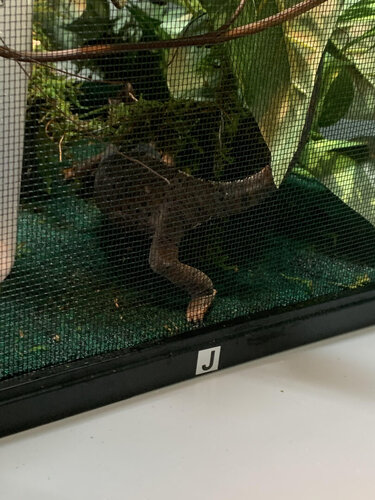
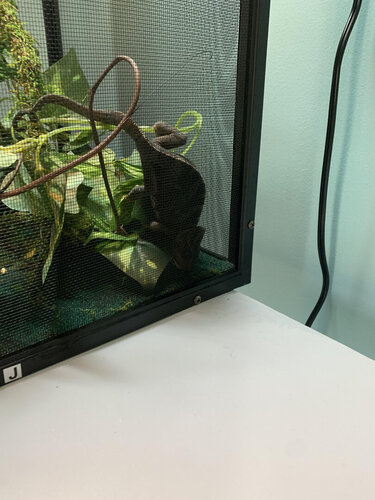
I was concerned about her being on the ground but now I know that I need a laying bin.
When receptive females will start looking for a male to fertilize their eggs, so they will be very restless for an period of time. Then they become gravid and become restless again as they are searching for a place to lay their eggs. You will need to make a good spot where the soil (I use washed play sand as it holds a tunnel very well) will hold a tunnel, and enough space that she can dig a few holes before she makes one she likes. I say she needs 10x10x10 of space. They really like to lay in a root ball, so I like to plant a privacy plant in the lay bin, but expect it to get destroyed. So a cheap little pothos does nicely for this. Females lay eggs roughly every 120 days, unless you can completely stop her cycle through diet.