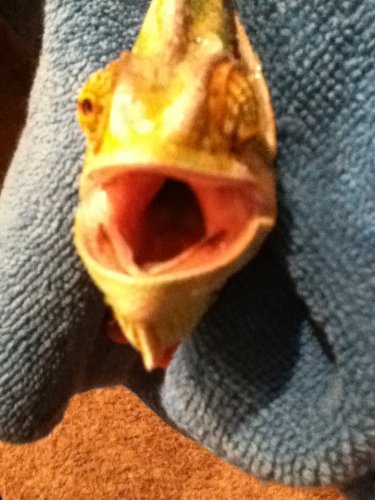
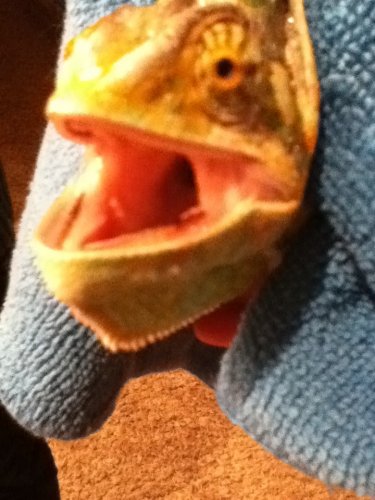
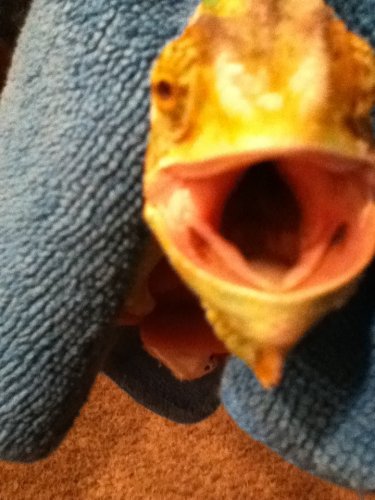
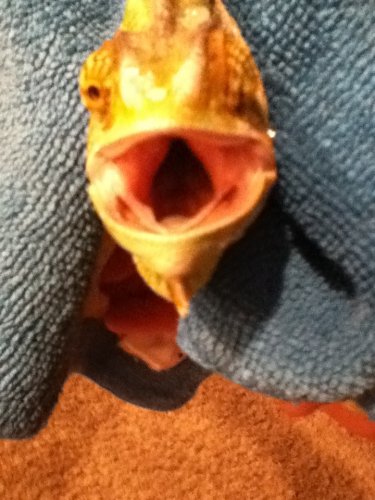
Unfortunately, your pictures don't help, cause the interesting parts (the teeth) aren't focussed at all. Maybe you can upload better pictures later on. In those pictures, the right dental ridge (seen from the chameleon, not from beholder) looks a bit deformed/thickened but it's too blurry to be sure.
Chameleon's teeth are part of the jaw bone, so they're really different to mammal teeth (which are made of adamantine and dentin, have a pulp and roots and are fixed by teethridge).
Here you'll find some pictures for better imagination.
Normally, brown coloured bone means it's necrotizing. A better examination could be done under anesthesia, cause you never have the ability to check every little detail in a struggling chameleon really carefully. There are often very tiny lesions you'd never noticed by just taking a look. It can even look like a completely normal mouth although there are multiple abscesses inside tissue. And most chameleons do still eat until their whole head is rotten. Were the teeth and jaw bones touched with e.g. a probe by your vet to check softening, rough surface or porosity? An x-ray could help to check bone structure of the affected areas, too. Pigmentation could be another reason for coloured tissue, but there's few probability that's the case in your chameleon. Pigmentation from external pigments would probably affect not only certain areas on both sides. Internal pigments might be an idea, but melanin has a very rare chance to reach bones symmetrically and other pigments (e.g. degradation products of haemoglobin) aren't seen in
healthy bones. Could even think about a calcium problem, but this wouldn't really change colour without a secondary infection or reduction of inner bone mass.
By the way, you feed too much worms imho... you're chameleon is already choosing his favourites, which means he's getting too much in general. And I would suggest doing fecals regularly, not only once a lifetime. One parasite free fecal doesn't mean the chameleon is parasite free categorically. There are lots of possibilities to have no parasite stages inside feces, but a high parasite burden inside the chameleon's body (hypobiosis, intermittently expulsion...). But the more often you let your reptile vet check fecals, the more increases correlation between parasite free fecal and parasite free chameleon.